Open-Cell vs Closed-Cell Spray Foam in Dallas–Fort Worth
Neither foam is universally "better." The right choice depends entirely on the structure, moisture conditions, framing depth, building use, and what performance problem you are trying to solve.
Get My Free QuoteAt Texas Foam Pro, we do not push one chemistry over the other. We design the foam system around the building.
Both products dramatically outperform traditional fiberglass because they combine insulation with air sealing. Where they differ is R-value per inch, moisture behavior, rigidity, cost, sound attenuation, best-fit assemblies, and vapor control strategy.
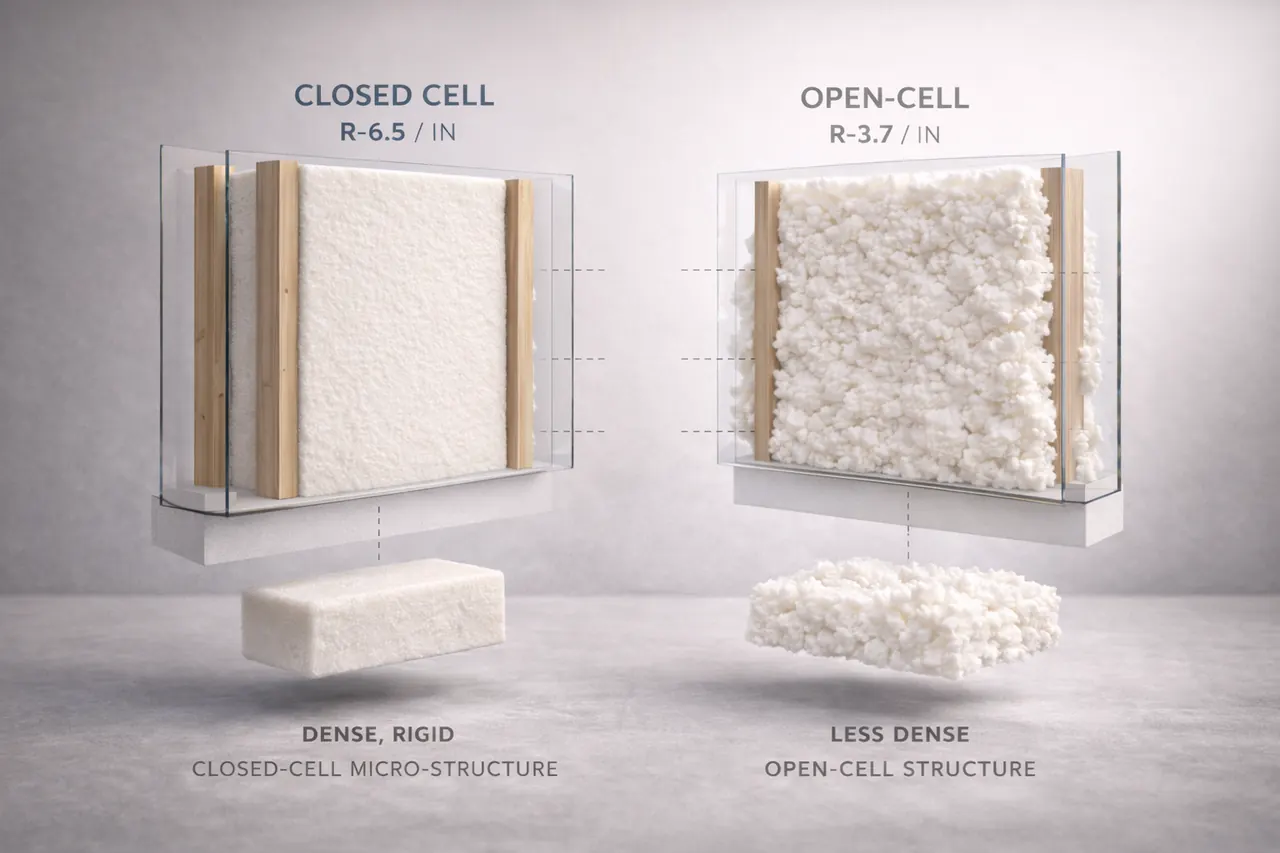
Closed-cell foam delivers a higher R-value per inch and a rigid, dense structure. Open-cell foam is softer and less dense, with excellent sound attenuation.
Open-Cell vs Closed-Cell at a Glance
| Feature | Open-Cell | Closed-Cell |
|---|---|---|
| R-value per inch | ~R-3.5 to R-4 | ~R-6 to R-7 |
| Air sealing | Excellent | Excellent |
| Vapor resistance | Low | High |
| Sound dampening | Excellent | Good |
| Structural rigidity | Minimal | High |
| Best for roof decks | Excellent | Excellent in select assemblies |
| Best for metal buildings | Not recommended on steel | Best choice |
| Cost | Lower upfront | Higher upfront |
| Best for crawl spaces | Rarely | Ideal |
| Best for rim joists | Good | Best |
| Best for shallow cavities | Fair | Excellent |
| Best for sound walls | Excellent | Good |
Where Each Foam Performs Best
Open-Cell: Best Uses
Open-cell excels in assemblies where large cavity fill matters, sound attenuation is important, or attic roofline encapsulation is the goal.
- Attic roof decks
- Wall cavities in 2x6 framing
- Media rooms
- Golf simulator spaces
- Detached offices
- Framed garages
- Sound-control partitions
- Conditioned bonus rooms
Closed-Cell: Best Uses
Closed-cell is the best choice when framing is shallow, moisture control is critical, or steel or masonry is involved.
- Metal buildings
- RV garages
- Crawl spaces
- Rim joists
- Pole barns
- Post-frame buildings
- Exterior 2x4 walls
- Cantilever floors
- Room-over-garage edges
- Detached conditioned shops
Is Closed-Cell Worth the Extra Cost?
Open-cell is generally the more budget-friendly choice because it expands more aggressively, uses less dense material, fills large volumes efficiently, and is ideal for deep attic rafters.
Closed-cell costs more because the material density is much higher, yield per set is lower, multiple lifts may be required, and it delivers higher R-value per inch along with vapor resistance and rigidity.
In many Texas projects, closed-cell can cost 30–100%+ more depending on thickness and access. But "more expensive" does not automatically mean "less cost effective." Texas Foam Pro helps clients decide based on best performance per dollar, not lowest bid.
Which One Handles Moisture Better?
Open-Cell: Vapor Permeable
Moisture vapor can move through it. This is a huge advantage in roof deck assemblies, allowing the roof sheathing to dry inward when the assembly is designed correctly. Ideal for: shingle roof conditioned attics, wood-framed wall cavities, sound walls, dry interior assemblies.
Closed-Cell: Vapor Retarder
Superior choice for: crawl spaces, rim joists, metal buildings, roof steel, wash bays, tack rooms, post-frame structures, shallow masonry transitions. Prevents condensation from forming on the inside face of metal panels, critical in Texas.
Which Is Better for Soundproofing?
Open-cell is the clear winner for sound attenuation. Because it is softer and less dense, it absorbs airborne sound exceptionally well. Texas Foam Pro uses open-cell extensively in: media rooms, golf simulators, nurseries, detached offices, pool-facing bedrooms, podcast studios, conference rooms, and game rooms.
What Works Best in Dallas–Fort Worth?
The DFW climate is hot, humid, and heavily cooling-dominated. Texas Foam Pro's most common DFW recommendations:
Use Open-Cell For:
- Attic roof decks under shingles
- Sound-control walls
- Large framed rooflines
- Media rooms
- Garages with framed roof systems
- Detached offices
Use Closed-Cell For:
- Metal shops
- Pole barns
- Crawl spaces
- Rim joists
- West-facing shallow 2x4 walls
- RV garages
- Roof steel
- Cantilever floors
- Room-over-garage edges
- Barndominium shop steel
For most DFW homes: open-cell wins the attic, closed-cell wins the edge conditions. That combination often creates the highest-performing home envelope.
How Texas Foam Pro Helps You Choose
We evaluate the following to build the right chemistry around the structure:
- 1Framing depth
- 2Roof type
- 3Moisture exposure
- 4HVAC location
- 5Sound goals
- 6Building use
- 7Wall orientation
- 8Steel vs wood substrate
- 9Budget
- 10Long-term performance goals
Still Not Sure Which Foam Is Right for You?
Texas Foam Pro will help you choose the right foam based on the way your structure is actually built, not a one-size-fits-all sales pitch.